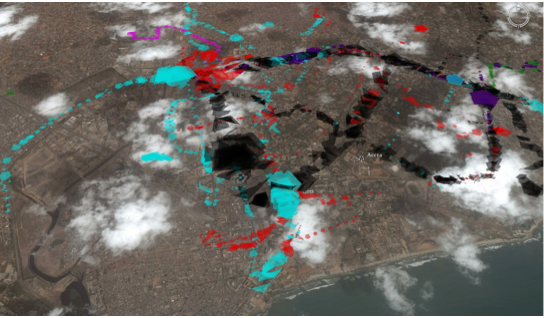
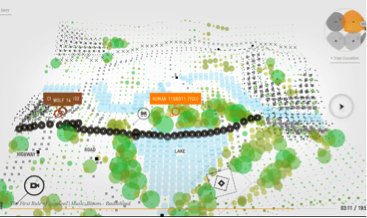
Like the term eco-poetics, eco-mapping draws its discursive power from the oikos, whose etymological traces are manifest in both the ecological and the economic. We use it to signify a bio- rather than an anthro-pocentric approach to the complex relationships between cartography and planetary ecosystems. We agree with Donna Haraway that it is the capitalocene, and not the anthropocene, that figures the threat of mass extinction for all biotic and abiotic life. We need not return “to deep time and the end of the last ice age” to make this claim efficacious or, as Haraway argues, advance
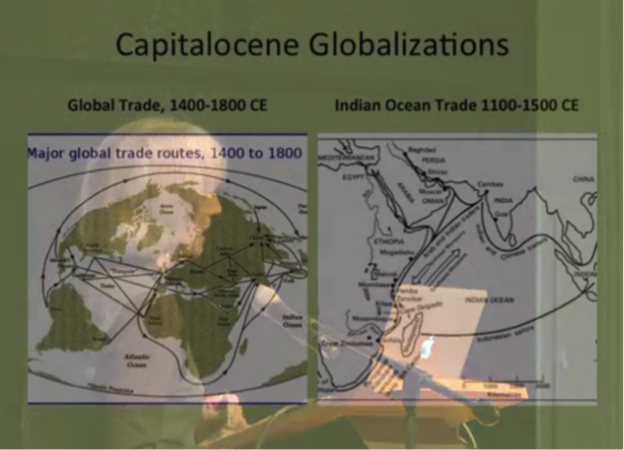
the notion that human versus nature is as old as our species itself. Stark nonsense. But we do need to go deeper in time than the mid-eighteenth century. I use this slide [figured above] simply to signal the formations of markets and accumulations of wealth in the great trade routes, many of which figured China as a major player and the Indian Ocean as a major player. I do this simply to signal that those metabolisms of the oikos and ecos — of economy and ecology, and of worlding and of trading and making need to be figured older than the mid-18th century, and that does not mean going back to some deep ecology.” (“Staying with the Trouble”)
Hence we begin with two assertions: first, the human is one element in a “multi-species being-with” that comprises and composes the continuous “worlding” of our planet. Second, it is capital that must be counter-mapped.
To this end, the term eco-mapping makes numerous conditions visible, among them
Dee Morris and Stephen Voyce, Eco-Mapping: Multiple directions | Jacket2