“With whom does historicism actually sympathize? The answer is inevitable: with the victor. And all rulers are the heirs of prior conquerors. Hence, empathizing with the victor invariably benefits the current rulers. The historical materialist knows what this means. Whoever has emerged victorious participates to this day in the triumphal procession in which current rulers step over those who are lying prostrate. According to traditional practice, the spoils are carried in the procession. They are called ‘cultural treasures,’ and a historical materialist views them with cautious detachment.… There is no document of culture which is not at the same time a document of barbarism. And just as such a document is never free of barbarism, so barbarism taints the manner in which it was transmitted from one hand to another. The historical materialist therefore dissociates himself from this process of transmission as far as possible. He regards it as his task to brush history against the grain.” Walter Benjamin, “On the Concept of History,” in Walter Benjamin: Selected Writings: Volume 4, 1938-1940, ed. Michael W Jennings (Cambridge, MA, and London: The Belknap Press of Harvard University Press, 2003), 391-392.
“In short, cultural history only seems to represent an advance in insight; actually, it does not entail even the semblance of an advance in the realm of dialectics. For cultural history lacks the destructive element which authenticates both dialectical thought and the experience of the dialectical thinker.” Walter Benjamin, “Edward Fuchs, Collector and Historian,” in Walter Benjamin: Selected Writings, Volume 3: 1935-1938, eds. Michael W Jennings and Howard Eiland (Cambridge, MA, and London: The Belknap Press of Harvard University Press, 2002), 268.
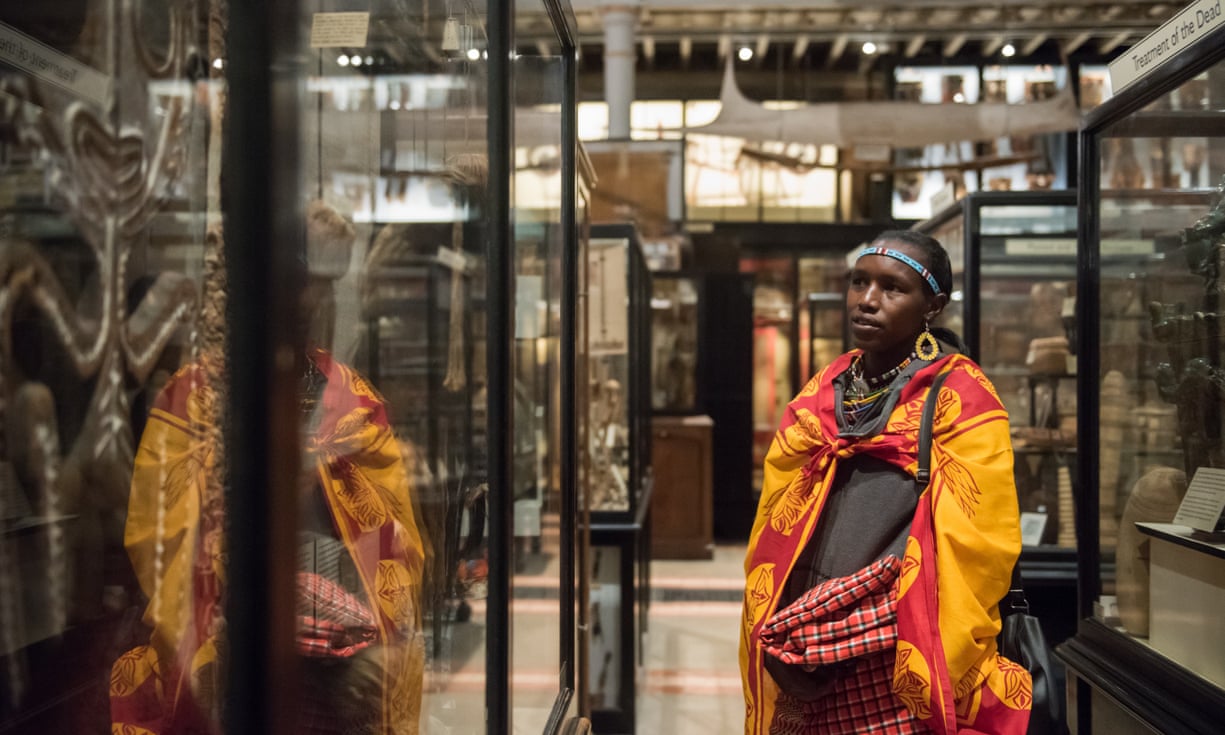
Image: Maasai tribeswoman Scholastica Ene Kukutia visits Oxford University’s Pitt Rivers Museum. From The Guardian (4 December 2018)